Almost everyone who visits in autumn tells me the same thing: kerosene is better up here, and it heats up faster. Our lounge sits at 1,444 m in Tsumagoi, Gunma. Our first winter here, before the heating went in, my wife and I pitched a tent inside the hall on the coldest nights and worked from inside it. Today the lounge (we call it the Kotatsu Lounge) heats with two Daikin commercial heat pumps, and what I read kept pointing the other way. So I checked the claim against manufacturer data, government figures and papers, and against our own sensors.
The place → tsumagoi.kensaur.us
Measuring it raised a bigger question first. Why are Japanese homes so cold in the first place? Below is what I found, from history to building codes, health, the newer heat-pump research and a few beliefs that turn out to be wrong. Our own numbers come after that, and at the end there is how to get help paying for a warmer home in Japan, as of 1 November 2026.
"Build a house for the summer"
Around the early 14th century, at the end of the Kamakura period, the monk Kenkō wrote in Tsurezuregusa (Essays in Idleness), section 55:
家の作りやうは、夏をむねとすべし。冬は、いかなる所にも住まる。暑き比わろき住居は、堪へ難き事なり。
"A house should be built with the summer in mind. In winter you can live anywhere, but a house that is bad in the hot season is unbearable." Nearly 700 years later it is still the line people quote to explain Japanese houses.
Japan's main encyclopedia (Nihon Daihyakka Zensho, entry "housing") says the open construction of the Japanese house was a response to the hot, humid climate. Timber alone doesn't explain it: Nordic log houses are timber and closed. As for winter, the same entry says people got through summer heat with through-draughts, and through the rainy season's damp and the winter's cold "mostly by enduring them".
Warm the body, not the room
Japanese has a word for it: saidan (採暖), defined in the Nihon Kokugo Daijiten as "taking warmth; warming the body with heat". It is distinct from danbō (暖房), heating the room. The encyclopedia calls the brazier, the sunken hearth and the kotatsu "local saidan rather than heating that warms a room". A housing lecture at Prefectural University of Kumamoto puts it in one line: "In Japan, saidan developed. The situation differs from Europe and America."
| Tool | Since |
|---|---|
| Irori, the sunken hearth | The hearth of pit dwellings, carried into raised-floor houses |
| Hori-gotatsu, the sunken kotatsu | Muromachi period (14th–16th c.), from the irori |
| Oki-gotatsu, the movable kotatsu | From the brazier; widespread by the Genroku era (1688–1704) |
| Yutanpo, the hot-water bottle | First recorded in 1486 |
| Tanzen / dotera, the padded robe | Early Edo period, around 1625 |
| Electric kotatsu | From about 1955; Japan's first electric yagura kotatsu was Toshiba's, 1957 |
Sources: Heibonsha World Encyclopedia, Nihon Kokugo Daijiten, National Museum of Nature and Science (industrial technology records). Our lounge is called the Kotatsu Lounge, and it still has one.
In England, by contrast, 95 % of owner-occupied and council homes have central heating (English Housing Survey 2023-24).
Insulation became compulsory in April 2025
| Year | What changed |
|---|---|
| 1980 | First energy-efficiency standard for homes |
| 1992 | Tightened |
| 1999 | Tightened again (today's insulation grade 4) |
| 2013, 2016 | Primary energy of the equipment is assessed too |
| April 2022 | Insulation grade 5 created |
| October 2022 | Grades 6 and 7 created (detached homes) |
| April 2025 | Every new home and building must meet the standard |
| By 2030 at the latest | Standard to be raised to the ZEH (net-zero-energy home) level |
Until March 2025, a small house could legally be built without meeting the standard at all: there was only a duty to try, and from 2021 a duty for the architect to explain it to the client. The existing stock is further behind. Of roughly 54 million homes, the ministry estimates that about 18 % meet the current standard and about 24 % have no insulation at all (fiscal 2022).
Windows show the gap most clearly. A U-value is how much heat leaks through; lower is better.
| U-value | |
|---|---|
| England, replacement window limit (Approved Document L, 2022) | 1.4 |
| England, new homes | 1.6 |
| Germany, replacement window limit | 1.3 |
| Japan, insulation grade 4 (regions 5–7, including Tokyo) | 4.7 |
| Japan, any single-glazed window (default value) | 6.51 |
New Japanese homes are catching up: in detached homes built in 2023–24, 36 % of window frames were all-resin and 61 % aluminium-resin hybrids (Japan Sash Manufacturers Association).
Houses also don't last long here. The ministry estimates the average age of a house when it is demolished at 35.7 years in Japan, 56.7 in the United States and 51.4 in England. Existing homes are 16.2 % of home sales in Japan, against 74.3 % in the US and 82.4 % in the UK (2023). When houses are torn down rather than sold on, money spent on insulation is harder to get back. That may be one reason insulation spread so slowly.
What cold homes do to people
The WHO Housing and Health Guidelines (2018) make a strong recommendation to protect residents from cold, with 18 °C as "a safe and well-balanced indoor temperature" in cold seasons, and say vulnerable groups may need more.
In Japan, winter is bath-accident season. In 2024, 7,776 people drowned in a bathtub, about 95 % of them aged 65 or over (Consumer Affairs Agency, from vital statistics). In 2023, 6,541 people aged 65+ died in bathtubs, about three times the 2,116 people of that age killed in traffic accidents. The agency's advice is water at 41 °C or below, no more than ten minutes, and warming the changing room and bathroom first.
The land ministry's Smart Wellness Housing study found that after insulation retrofits, residents' morning systolic blood pressure fell by 3.5 mmHg on average (interim report, January 2019). People in homes whose living room was below 18 °C in the morning had higher cholesterol and more ECG abnormalities, after adjusting for age, sex, income and lifestyle.
Do heat pumps give up in the cold?
The usual worry is that an air conditioner can't heat somewhere cold. The research of the last few years says otherwise.
- Field data. Gibb and colleagues (Joule, 2023) pooled seven field studies, about 550 systems, and found an average COP of 2.74 between 5 and −10 °C. Cold-climate models stayed above 2 at −20 °C.
- The US Department of Energy's Cold Climate Heat Pump Challenge. Eight manufacturers, Daikin among them, built units for a lab target of a COP of 2.1–2.4 and full capacity at −15 °C (5 °F). In homes, from winter 2022 to 2024, 22 units recorded a median COP of 1.9 at −18 to −15 °C, and backup resistance heat was almost never used (PNNL report 37127).
- Japan's cold-region air conditioners. Daikin and Mitsubishi Electric sell home units that keep running at −25 °C outside (Daikin notes this is not a capacity guarantee). Mitsubishi's give their standard rated heating at −15 °C. Our commercial units are rated at 16.5 kW at −15 °C.
Worldwide, heat pumps met about a tenth of space-heating needs in 2021 (IEA). Sales fell about 2 % in 2025; Europe grew 11 %, the US fell 13 %, and Japan was flat.
The refrigerants are changing too. Most new Japanese air conditioners use R32, with a global warming potential of 675 against 2,090 for the R410A it replaced (Ministry of the Environment table). Japan's rules set 750 as the target for new air conditioners, and under the Kigali Amendment developed countries cut HFCs 85 % by 2036. The EcoCute water heater uses CO2 as its refrigerant; it went on sale in 2001 and passed 10 million units shipped by March 2025.
Five things people still believe
| Belief | What the sources say |
|---|---|
| Air conditioners stop working below freezing | Cold-climate models give their rated heat at −15 °C and keep running at −25 °C. Efficiency drops, to a COP of about 2 at −20 °C. |
| Switching off whenever you can saves the most | Daikin's 2018 winter test in two Kyoto flats: switching off every 30 minutes used more than leaving it on. For a two-hour outing, switching off used less (2.4 vs 3.4 kWh). Over a whole day, switching off saved about ¥30. |
| Kerosene is always cheaper | It depends on the electricity contract. On our power contract a kWh of heat costs ¥9.1 in November, against ¥13.9 from kerosene. At a household contract's top-tier price it would be ¥14.7, more than kerosene. |
| A big room needs a kerosene fan heater | Home fan heaters give 2.5 to about 7 kW. One of our heat pumps gives over 16 kW. |
| Heat pumps dry the air | Heating removes no water. Warmer air simply has a lower relative humidity (Daikin). Burning a litre of kerosene adds about a litre of water. |
Two official figures for a 2.5 kW unit: setting it 1 °C lower all heating season saves 15.8 kWh, about ¥490; cleaning the filter once or twice a month saves 37.9 kWh, about ¥1,170 (Agency for Natural Resources and Energy).
With that background, here is what we measured in our own lounge.
What our sensors saw on 30 October
The lounge had been unheated all morning. At 13:28 it was 13.3 °C inside and about 10 °C outside. The heat pump was switched on (one unit). At 13:53 the lounge meter read 18 °C, and at 14:12 it read 20.0 °C: 6.7 °C in 44 minutes, or 0.15 °C a minute. The unit went off at about 14:13 (I read that from the curve, not a log), and the air fell back to 17.3 °C by 15:00.
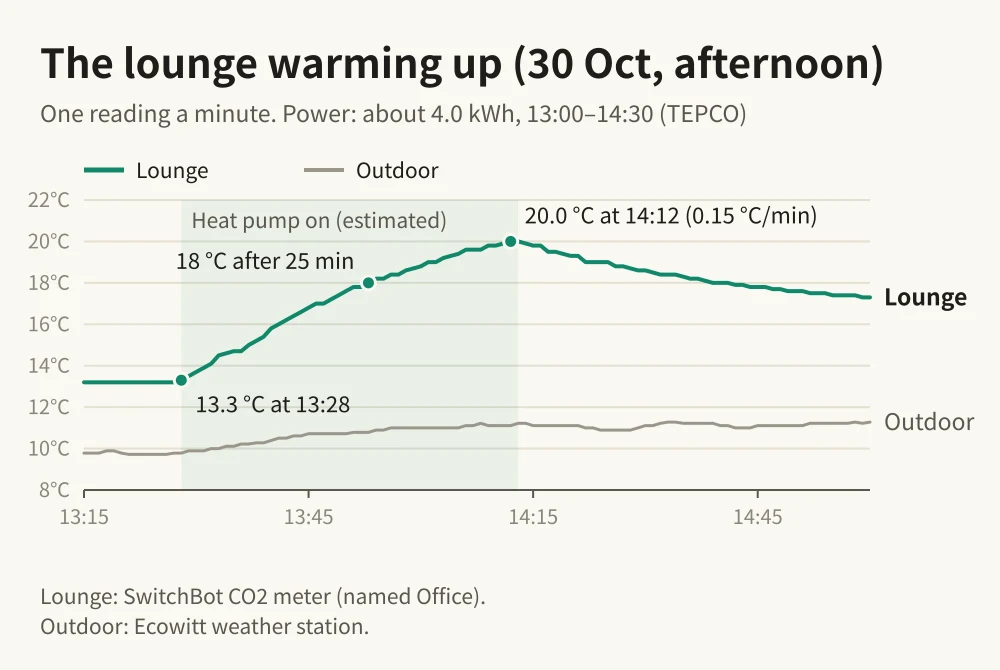
This shows how fast the air around one sensor warmed. TEPCO's half-hourly readings for our power contract show about 4.0 kWh above the usual background across 13:00–14:30, about ¥82 at October's rate. Use already went up in the 13:00–13:30 slot, so the unit was probably on a few minutes before the lounge sensor saw the air warm. I don't yet have the room's volume, so I can't turn the curve into kilowatts of heat. A second thermometer in the building, inside the weather-station gateway, rose only from 14.4 to 16.5 °C. Air near the outlet warms first. Walls, floor and furniture take longer.
"Kerosene heats faster": where it's true
A kerosene fan heater blows hot air within a minute or two of switching on, and the spot in front of it gets warm quickly. A heat pump takes a few minutes before its air is warm. Our own runs showed it: the kerosene burner moved the lounge meter within a minute, the heat pump after seven. In cold, damp weather it also pauses now and then to melt frost off the outdoor coil. Daikin says so in plain words: when a lot of frost builds up, the unit stops heating and runs a defrost cycle.
Warming a whole room is a different question. How fast it goes depends mostly on how many kilowatts of heat reach the room. Home kerosene fan heaters in this year's catalogues give 2.5 to about 7 kW at full output, and the makers' association (JGKA) sizes a 16-mat wooden room in a mild region at 6.4 kW. Ours are Daikin スゴ暖ZEAS SDRV160C units (Daikin's line for cold regions; indoor FVP160FC, outdoor RDRP160C). Daikin rates each at 16.0 kW at 7 °C outside, 16.5 kW at 2 °C (averaged over an hour, so the defrost time is counted) and 16.5 kW at −15 °C. That is several fan heaters' worth per unit, with no exhaust in the room.
What a kilowatt-hour of heat costs here
The heat pumps run on our three-phase power contract (TEPCO's 動力プラン). In October that cost ¥20.45 per kWh: the unit price, minus the fuel-cost adjustment, plus the renewables levy. In November it rises to ¥24.47. Kerosene in Gunma was ¥141.7 a litre at the pump and ¥152.4 delivered (government survey, 26 October). A litre of kerosene holds 10.17 kWh of heat.
A heat pump moves more heat than the electricity it uses. Daikin's figure for our model is a COP (heat out ÷ electricity in) of 3.07 at 7 °C and 2.68 at 2 °C, with defrost included. The IEA puts a typical household heat pump at about 4. Japan's own efficiency working group notes that cold-climate models give up some of that in exchange for capacity in the cold.
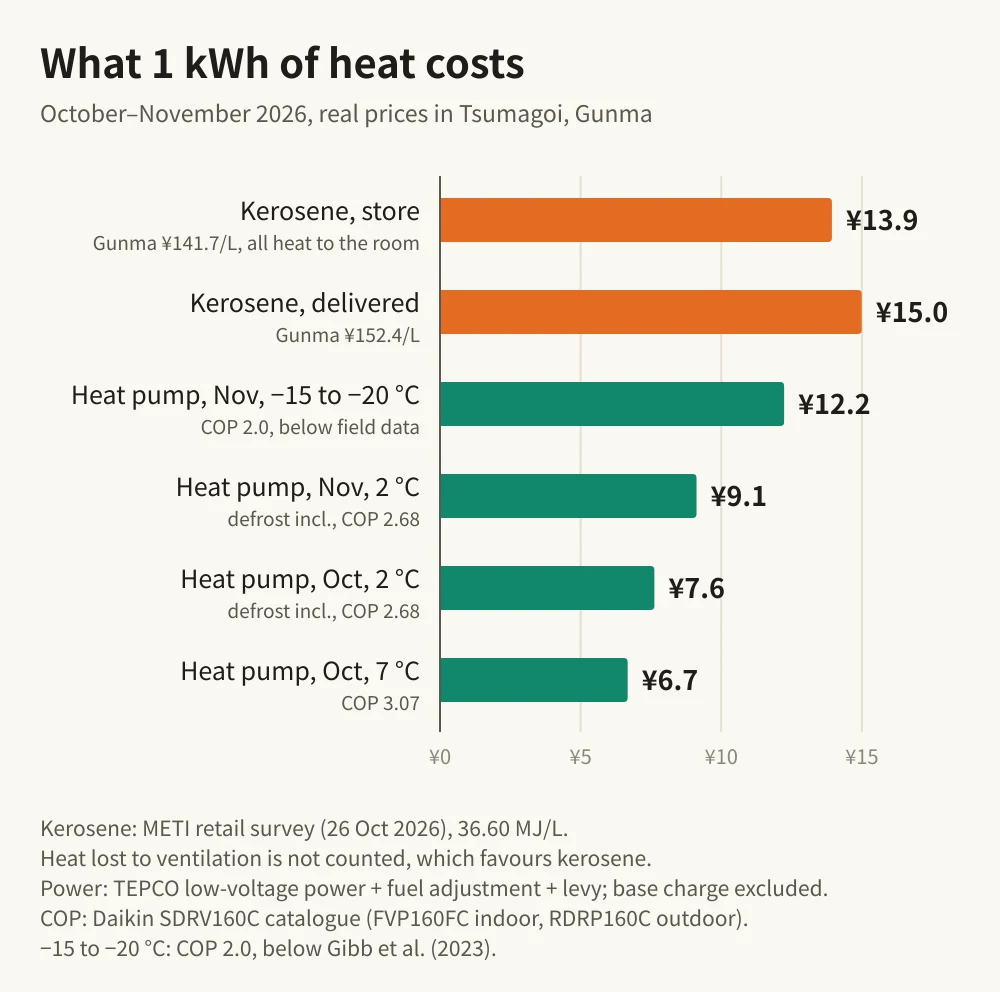
The working, in one line each:
- Kerosene: ¥141.7 ÷ 10.17 kWh = ¥13.9 per kWh of heat (¥15.0 delivered).
- Heat pump at 2 °C: ¥20.45 ÷ 2.68 = ¥7.6 in October, ¥24.47 ÷ 2.68 = ¥9.1 in November.
- Heat pump at 7 °C: ¥20.45 ÷ 3.07 = ¥6.7.
The contract matters. Bought at a household lighting contract's top-tier price (¥39.39 per kWh in November), the same heat would cost ¥14.7 per kWh at 2 °C, more than kerosene.
Colder nights lower the COP. A 2023 review of field and lab data (Gibb et al., Joule) found an average COP of 2.74 between 5 and −10 °C across about 550 heat pumps in seven field studies, and cold-climate models still above 2 at −20 °C. At a COP of 2.0, heat from our power contract costs ¥12.2 per kWh in November, still below kerosene's ¥13.9. The heat pump stays cheaper as long as its COP is above about 1.8 (¥24.47 ÷ ¥13.9).
CO2, and the energy behind the plug
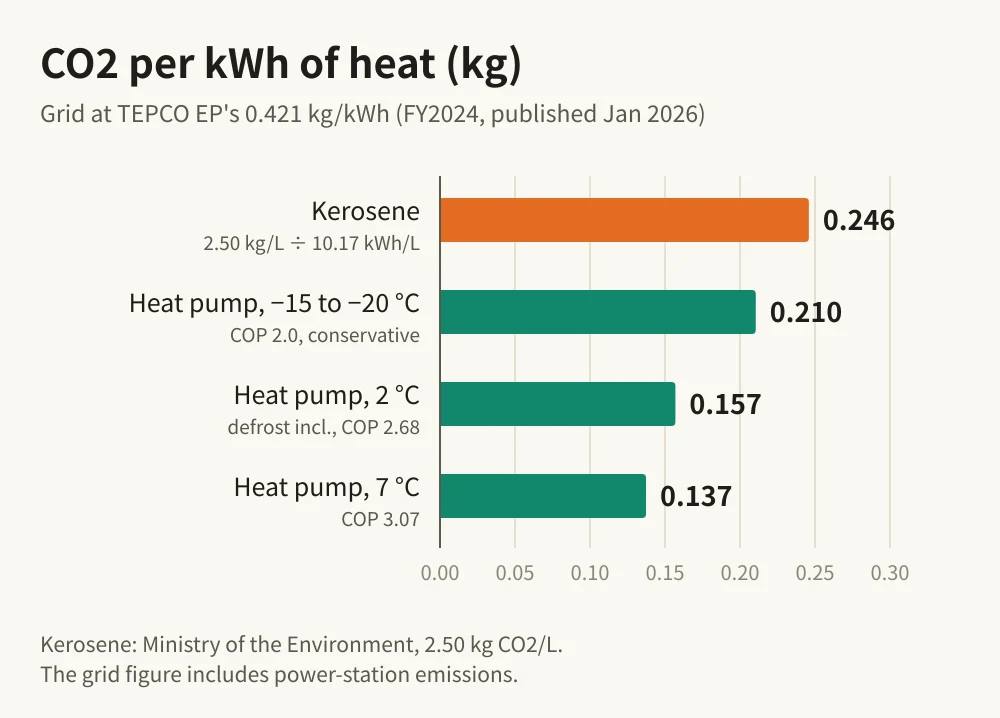
Burning a litre of kerosene releases 2.50 kg of CO2 (Ministry of the Environment), so 0.246 kg per kWh of heat. TEPCO's electricity carried 0.421 kg per kWh in its latest published year. Divided by the COP, that gives 0.157 kg at 2 °C and 0.137 kg at 7 °C.
One number where the gap is small: Japan counts each kWh of grid power as 8.64 MJ of primary energy, for fuel burned at power stations. At a COP of 2.68, a kWh of heat from the heat pump takes 3.22 MJ of primary energy. From kerosene it takes 3.60 MJ. On a 2 °C day the gap on that measure is only about a tenth. The heat pump pulls ahead when it is milder, and as the grid gets cleaner.
What stays in the room
Most kerosene fan heaters are unvented (開放式): the flame's exhaust goes into the room you're sitting in. Chamber studies from the 1980s found one hour of an unvented kerosene heater in a small room pushed CO2 and NO2 well above air-quality limits. A 1996 test in a Japanese room found the same against Japan's standards, and ventilation cut the nitrogen oxides to under a third. A litre of kerosene also makes about a litre of water. That water is the condensation on cold windows in winter. Japan's product-safety agency NITE advises airing the room once or twice an hour.
Airing the room throws heat away, and that cost is easy to work out. Japan's building-hygiene law sets 1,000 ppm of CO2 as the line for managed buildings. Holding a room at 1,000 ppm against the CO2 from an unvented kerosene heater takes about 223 m³ of outside air an hour for every kilowatt of heat, before you count people. Once it is about 13 °C colder outside than in, that air carries away more heat than the heater makes. That is why rooms heated this way tend to sit above 1,000 ppm, as the 1996 Japanese test found.
Does 1,000 ppm affect thinking? The evidence is mixed. A 2016 study by Allen and colleagues found better decision scores in well-ventilated, low-CO2 offices, but CO2 wasn't the only thing that changed. A 2017 study by Zhang and colleagues found no effect from pure CO2 at 1,000 to 3,000 ppm. Reviews in 2019 and 2020 called the results inconsistent, and ASHRAE said in 2025 that CO2 isn't an overall measure of indoor air quality. I don't claim the lounge makes anyone sharper. I want fresh air without paying to heat it twice.
Where kerosene still wins, and where we use it
- Very cold nights. Heating capacity falls as it gets colder, and the APF efficiency rating is worked out for Tokyo's weather. Daikin lists our unit at 16.5 kW at −15 °C and gives nothing below that. The 2023 review found COPs of 1 to 2 at −30 °C. The coldest nights at 1,444 m are where the heat pump is weakest.
- Defrost. Frost forms most readily between about −7 and 5 °C in humid air (Song et al., 2018). One manufacturer's FAQ puts the defrost at once every 30 to 90 minutes, for up to 10 minutes, with no warm air while it runs. The 2 °C figure above already includes those pauses.
- Power cuts. A heat pump needs power. So do most kerosene fan heaters, for the fan and ignition. The JGKA lists kerosene fan heaters among the appliances that can't be used in a power cut. The IEA warns that heating with electricity adds exposure to outages in cold climates.
- Upfront cost. Daikin's list price for one SDRV160C set is ¥1,631,000 before installation, against a few tens of thousands of yen for a fan heater.
- Hot water and open spaces. Our hot-water boiler burns kerosene. For a big open shelter we rent out a commercial kerosene burner, and I run it myself. Both are the right tool for their jobs. The lounge, a closed room where people sit for hours, isn't one of them.
Thirty minutes on a colder night
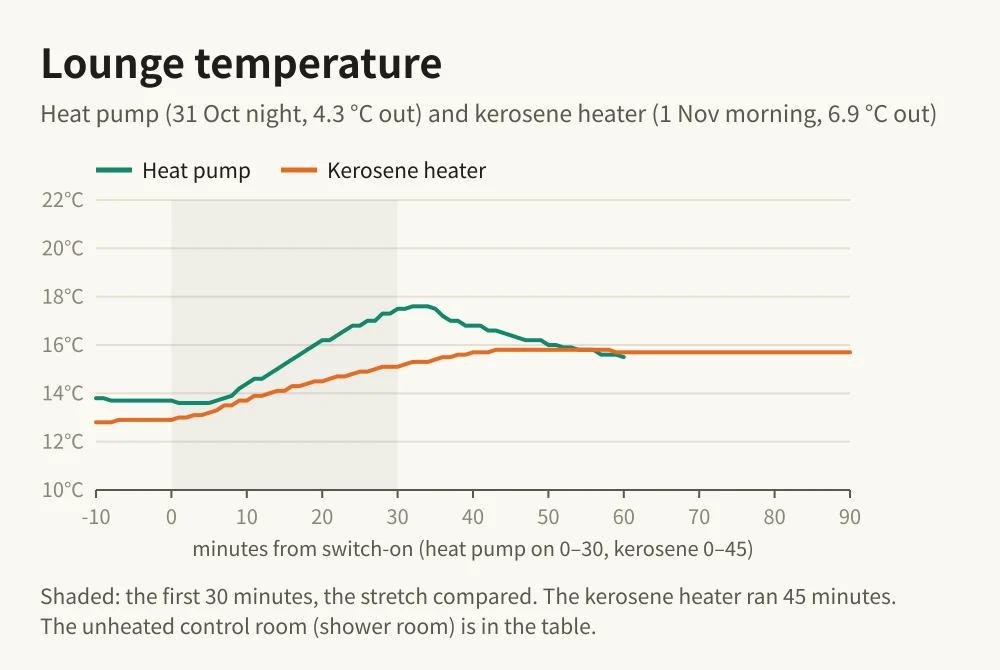
On 31 October it was 4.3 °C outside and 13.7 °C in the lounge. The heat pump went on at 22:30, heating at 20 °C, and off at 23:00. One unit ran; the power reading below fits that. The air started to warm at 22:37, seven minutes after switch-on. By 23:00 it was 17.5 °C: 0.13 °C a minute on average while it ran, and 0.19 °C a minute over the fastest ten minutes. It reached neither 18 °C nor 20 °C in that half hour. After it went off the lounge peaked at 17.6 °C at 23:02 and fell to 15.5 °C by 23:30.
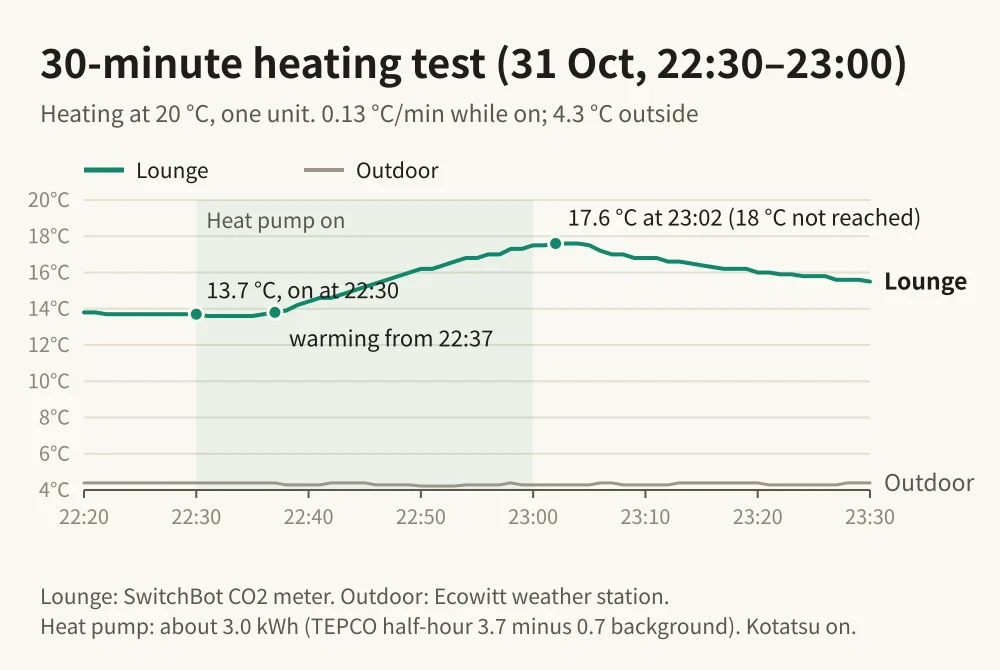
In the first thirty minutes the lounge rose about 5 °C on the afternoon run (10 °C outside) and about 3.8 °C on this one (4 °C outside, including the seven-minute start). That's two runs, but the colder night gave the smaller rise.
This time I have the electricity too. TEPCO's meter for our power contract reports every half hour, in steps of 0.1 kWh. It read 3.7 kWh for 22:30–23:00. The half hours either side read 0.7, and the rest of that day sat at 0.6–0.8: that is the water pump and the kitchen fridge, which share the contract. Taking 0.7 as the background, the heat pump used about 3.0 kWh in the half hour (2.9 to 3.1 if the background was 0.6 to 0.8), or about 6.0 kW on average. Daikin's figure for one unit making 16.5 kW of heat at 2 °C is 6.15 kW of electricity, and two units would draw about twice that, so the reading fits one unit running close to that rating.
At October's ¥20.45 that half hour cost about ¥61 (¥73 at November's rate). The heat it made is an estimate, not a measurement: 3.0 kWh times Daikin's COP of 2.68 is about 8.0 kWh. Getting 8.0 kWh from kerosene takes 0.79 litres, about ¥112 at the Gunma pump price, with every bit of its heat counted. Only a small part of that heat warms the air itself; the rest goes into the walls, floor and furniture, and out through the building.
The same half hour with kerosene
The next morning, 1 November, we ran the other side. The heater was the commercial kerosene burner we rent out, a Corona GH-G19F(A), rated 6.07 to 18.73 kW, set to 20 °C. Doors shut, kotatsu off, heat pump off, and one window cracked open, as the heater's manual asks. We don't otherwise run it in the lounge; this was a one-off test. It was 5.8 °C outside and 12.9 °C in the lounge at 09:00. It ran until about 09:45.
It started warming at once: 13.0 °C after one minute, where the heat pump had taken seven. After 30 minutes the lounge was at 15.1 °C, and after 45 minutes 15.8 °C. It was a sunny morning, so I used a control: the shower room at the back of the building, which is unheated, rose 0.4 °C over the same 30 minutes, and I subtracted that. On the heat pump's night run the same room fell 0.1 °C.
| Heat pump (31 Oct, 22:30) | Kerosene (1 Nov, 09:00) | |
|---|---|---|
| Outside (average) | 4.3 °C | 6.9 °C |
| Lounge at start → after 30 min | 13.7 → 17.5 °C | 12.9 → 15.1 °C |
| Rise, raw | 3.8 °C | 2.2 °C |
| Unheated shower room, same 30 min | −0.1 °C | +0.4 °C |
| Rise, corrected | 3.9 °C | 1.8 °C |
| Energy used | 3.0 kWh electricity (metered) | 0.30–0.91 L kerosene (estimated) |
| Cost | ¥61 (metered) | ¥42–129 (estimated) |
| CO2 at start → after 30 min | 556 → 520 ppm | 614 → 1,446 ppm |
| Humidity at start → after 30 min | 52 → 46 % | 53 → 52 % |
The kerosene figures are estimates, because nobody weighed the tank. Corona's manual puts the burner between 0.59 and 1.82 litres an hour. The lounge stayed far below the 20 °C setting and the curve never eases off, so I read it as running near full output. That would be about 0.91 litres in 30 minutes, about ¥129 and 9.3 kWh of heat. At its lowest setting it would have been 0.30 litres, ¥42 and 3.0 kWh. The heat pump's 3.0 kWh is metered. Next time we weigh the tank.
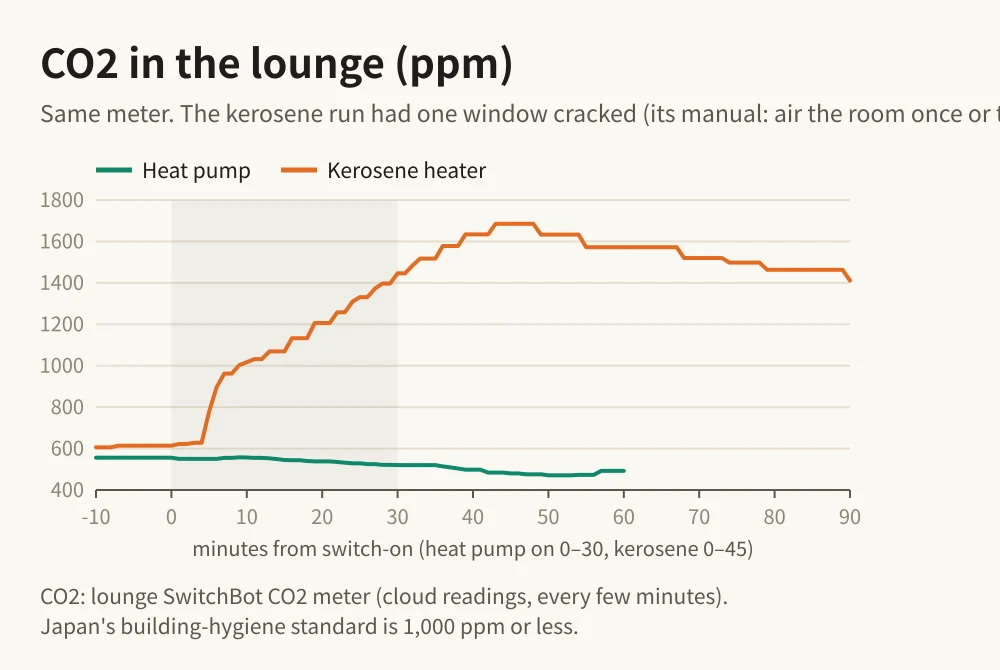
CO2 is where the two runs differ most. With the heater on, CO2 in the lounge went from 614 to 1,446 ppm in 30 minutes and peaked at 1,685 ppm at 09:43, just before the heater went off. At 10:30, 45 minutes after it went off, it was still 1,411 ppm. During the heat pump run it went from 556 to 520 ppm. The lounge is a large room and one window was open; these are the meter's readings. Humidity held steady with kerosene (53 to 52 %), because burning kerosene adds water as the air warms. With the heat pump it fell from 52 to 46 %, as warming air does.
The two runs weren't identical: night against a sunny morning, 4.3 against 6.9 °C outside, a window open for the kerosene run, and the kerosene fuel is estimated. Within that, the heat pump raised the lounge about twice as much in 30 minutes, with no rise in CO2, and, if the burner ran near full output, for about half the money. The kerosene heater was quicker for the first few minutes. I'll run both again on a properly cold night.
What you can do: subsidies in Japan, as of 1 November 2026
If this has you looking at your own windows or water heater: the national Housing Energy Saving 2026 campaign (住宅省エネ2026キャンペーン) is still open, but not for long. Bookings close on 16 November 2026 and applications on 31 December 2026, or earlier if a budget runs out.
| Programme | Covers | Amount | Budget applied for |
|---|---|---|---|
| 先進的窓リノベ2026 (Ministry of the Environment) | Inner windows, new windows, glass replacement | Up to ¥1,000,000 per home | 33 % |
| みらいエコ住宅2026 (Land ministry) | Insulation and other renovation; efficient new homes | Renovation up to ¥400,000–1,000,000 per home | 12 % (renovation) |
| 給湯省エネ2026 (METI) | EcoCute and other efficient water heaters | EcoCute ¥70,000 per unit, plus ¥30,000 for top models | 55 % |
The part that surprised me: you don't apply yourself. The registered contractor does.
- Find a contractor registered with the campaign, and check the registration before you sign.
- Sign the works contract. Work must start after the contract.
- Sign the joint-project agreement (共同事業実施規約) with the contractor.
- When the work is finished and handed over, the contractor files the application.
- One to two months after approval, the subsidy comes back to you through the contractor, off the bill or in cash.
The window programme covers work started on or after 28 November 2025. Whether two programmes can be combined on one home (windows and a water heater, say) is a question for your contractor. Local schemes can be searched on the Housing Renovation Promotion Council's site (地方公共団体における住宅リフォームに係わる支援制度検索サイト). Our village, Tsumagoi, has rules for a home solar and battery subsidy; ask the village office whether it is taking applications this year.
For certification there is BELS (a third-party energy rating), ZEH (net-zero-energy home) and 長期優良住宅 (the long-life quality housing certificate, issued by the local authority, with tax reductions). Since April 2024, adverts for new homes for sale or rent are expected to show an energy-performance label.
We haven't got any of these certifications yet. We rushed to open. It's on our list.
Small businesses can get up to a third of the cost of efficient commercial air conditioners through METI's energy-saving subsidy (省エネ・非化石転換補助金, run by SII). The fourth call of this round closed on 30 October 2026 and the next one hasn't been announced. One rule matters more than any other there: signing or ordering before the grant decision makes the project ineligible. SII also runs subsidised energy audits for small businesses, from ¥6,006 per item.
What we'll do next
- Run both again on a properly cold night, below −10 °C, with the kerosene tank on a scale.
- Measure the lounge's volume, so the curves turn into kilowatts of heat.
- Log the power directly once the meter's B-route link is live, instead of reading half-hourly totals.
- Work out what the windows and a certification would take, against the subsidy rules.
If you run a cold building and have measured this yourself, I'd like to compare notes.
Sources
- Daikin, スゴ暖ZEAS catalogue CP26091XXX (June 2026), spec table p. 38, JIS B 8616:2015 conditions; cold-climate portal ac.daikin.co.jp/kanreichi
- Agency for Natural Resources and Energy, retail petroleum price survey, 26 Oct 2026 (enecho.meti.go.jp); standard heating values 2023 (rev. Mar 2025)
- TEPCO Energy Partner: low-voltage power tariff from 1 Nov 2026, fuel-cost adjustment (press release 29 Sep 2026), lighting tariff list; METI, renewables levy FY2026 (19 Mar 2026)
- Ministry of the Environment / METI: emission factors by power company, FY2024 results (published Jan 2026); calculation factor list (kerosene 2.50 t-CO2/kL)
- Gibb D, Rosenow J, Lowes R, Hewitt NJ. Coming in from the cold: heat pump efficiency at low temperatures. Joule 7(9), 2023. doi:10.1016/j.joule.2023.08.005
- IEA, The Future of Heat Pumps, 2022
- METI working group on air-conditioner standards, 8 Feb 2022 (cold-climate definition at −7 °C and −15 °C; APF based on Tokyo)
- Song M et al. Applied Energy 211:1150, 2018. doi:10.1016/j.apenergy.2017.12.022 (frost forms at −7 to 5 °C above 65 % RH)
- Japan Gas Appliances Manufacturers' Association (JGKA): unvented vs FF heaters, sizing guide, appliances in a power cut
- Traynor GW et al. Environ Sci Technol 17:369, 1983. doi:10.1021/es00112a012; Arashidani K et al. Ind Health 34:205, 1996. doi:10.2486/indhealth.34.205
- Ministry of Health, Labour and Welfare: building environmental hygiene standards (CO2 ≤ 1,000 ppm; CO ≤ 6 ppm since Apr 2022); NITE combustion-appliance handbook (air the room 1–2 times an hour)
- Allen JG et al. EHP 124:805, 2016; Zhang X et al. Indoor Air 27:47, 2017; Du B et al. Indoor Air 30:1067, 2020; ASHRAE position document on indoor CO2, Feb 2025
- Kenkō, Tsurezuregusa §55, text at Yamanashi Prefectural University (yamanashi-ken.ac.jp); Nihon Daihyakka Zensho "住宅", Nihon Kokugo Daijiten "採暖", "湯婆", Heibonsha World Encyclopedia "炬燵", "囲炉裏", "丹前" (via kotobank.jp); National Museum of Nature and Science, industrial technology records (Toshiba electric kotatsu, 1957); Prefectural University of Kumamoto, housing lecture notes (2009)
- MLIT: housing economy data FY2025 (average age of demolished homes, existing-home share); standards history and design guide (Mar 2025); insulation grades 5–7; mandatory compliance from Apr 2025 and the 2030 ZEH level (mlit.go.jp/shoene-jutaku); housing stock insulation, FY2022 estimate; grade-4 window U-values
- UK Government, Approved Document L, Vol. 1 (2021 ed., in force 15 Jun 2022); English Housing Survey 2023-24 headline report; German building-energy law, Annex 7 (gesetze-im-internet.de); Japan Sash Manufacturers Association: single-glazing default U-value (Jul 2025), window frames in new homes (Mar 2025)
- WHO Housing and Health Guidelines, 2018; Consumer Affairs Agency, bath accidents (23 Dec 2025; column 19 Dec 2024); Government public relations online (12 Nov 2025); MLIT Smart Wellness Housing study, 3rd interim report (24 Jan 2019)
- IEA, Global Energy Review 2026 (heat pumps); US DOE Residential Cold Climate Heat Pump Challenge, and PNNL-37127 field validation; Daikin and Mitsubishi Electric cold-region product pages; Cabinet Office, 今週の指標 No. 1411 (28 Apr 2026)
- Ministry of the Environment: refrigerant GWP table (Jul 2023), designated-product targets; MOFA, Kigali Amendment (Oct 2016); JRAIA / Heat Pump & Thermal Storage Technology Center, EcoCute 10 million units (11 Apr 2025)
- Daikin, winter on/off experiment (16 Feb 2018) and "why heating feels dry"; Agency for Natural Resources and Energy, energy-saving portal (setpoint and filter figures)
- Housing Energy Saving 2026 campaign (jutaku-shoene2026.mlit.go.jp, status 1 Nov 2026); 先進的窓リノベ2026, みらいエコ住宅2026, 給湯省エネ2026 official sites; Housing Renovation Promotion Council local-scheme search; Tsumagoi village subsidy rules; MLIT energy-performance label; BELS (Housing Performance Evaluation and Display Association); Ministry of the Environment ZEB tiers; SII energy-saving subsidy, 4th call (updated 30 Oct 2026) and energy audits